Design and Implementation
of a Micro-Credential Framework
at King Mongkut's University of Technology Thonburi (KMUTT), Thailand
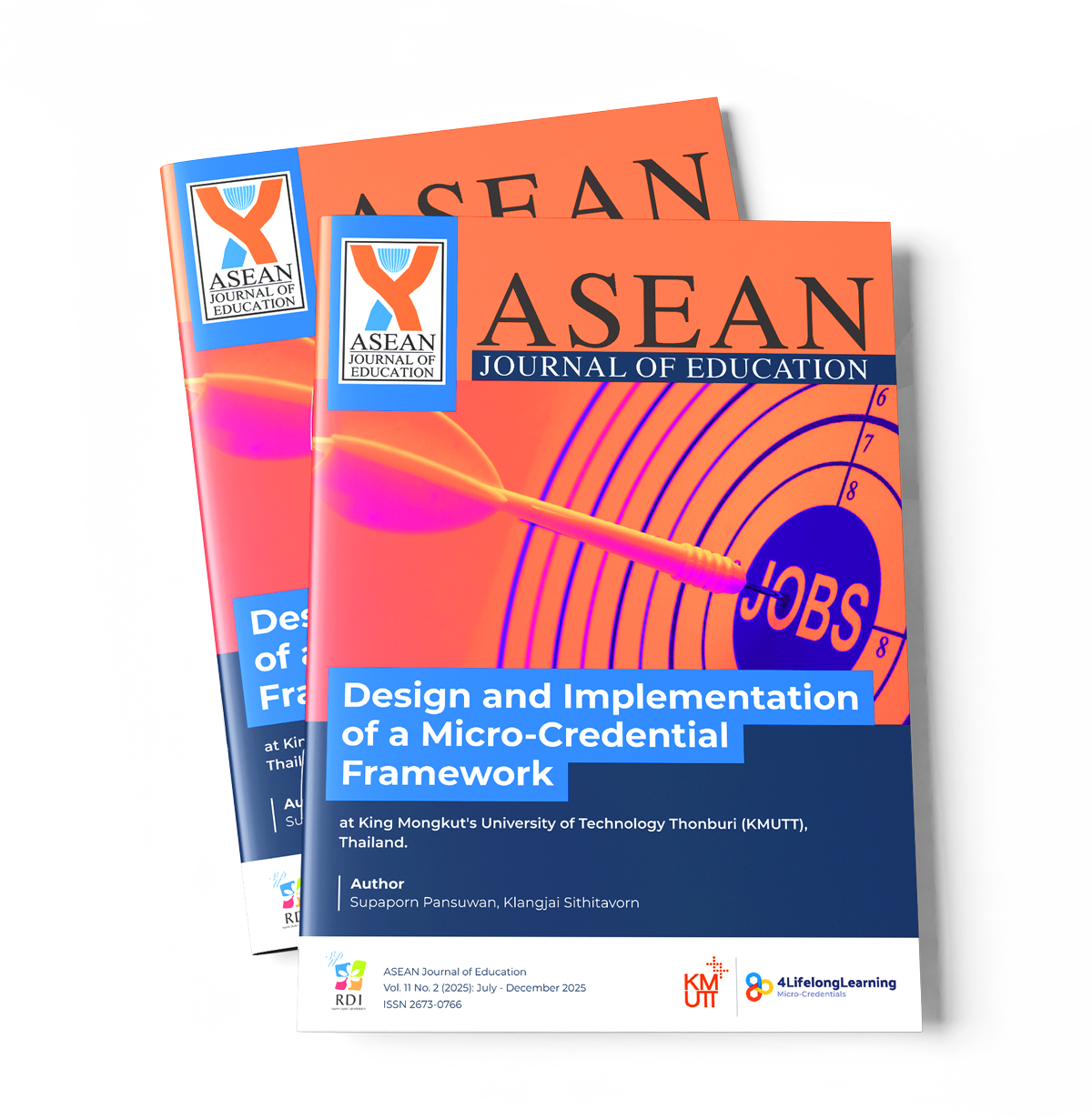
This study presents KMUTT’s framework for developing and implementing Micro-Credentials, adapted from the Digital Promise model and aligned with Outcome-Based Education (OBE). The framework emphasizes competency assessment and evidence of authentic performance, rather than traditional content-focused approaches.
It consists of three phases—planning, development, and implementation—and was piloted across four disciplinary areas: business, technology, education, and science and engineering.
The paper highlights KMUTT’s role as an early adopter and key contributor in advancing Micro-Credentials in higher education and offers a practical model for institutions seeking to design Micro-Credentials that prioritize verified learner competencies.
It consists of three phases—planning, development, and implementation—and was piloted across four disciplinary areas: business, technology, education, and science and engineering.
The paper highlights KMUTT’s role as an early adopter and key contributor in advancing Micro-Credentials in higher education and offers a practical model for institutions seeking to design Micro-Credentials that prioritize verified learner competencies.
Author
Supaporn Pansuwan & Klangjai Sithitavorn
This Research Journal was published in
ASEAN Journal of Education Vol. 11 No. 2 (2025)